
Let me guess...
You have a business planner. Maybe two. (Maybe the one you grabbed at Target in January because THIS was going to be the year.)
And somewhere under your desk, there's a little planner graveyard. A stack of notebooks with one really great week in them... and then nothing.
I get it. Because that was me.
When I was teaching full time, I built my business in 90-minute plan periods. Two kids at home. Coaching after school. And I had a planner (or three) for EVERYTHING.
But I'd still sit down to work and have no idea what to do first.
The planner wasn't the problem. I just didn't have a system telling me what to put in it.
So here's the deal... a business planner holds your to-do list. A planning SYSTEM helps you decide what's actually worth doing, and gives you a simple way to do it every single week.
If your business planner isn't working, you probably don't need a new one. You need a system.
Here are 5 signs you're there.
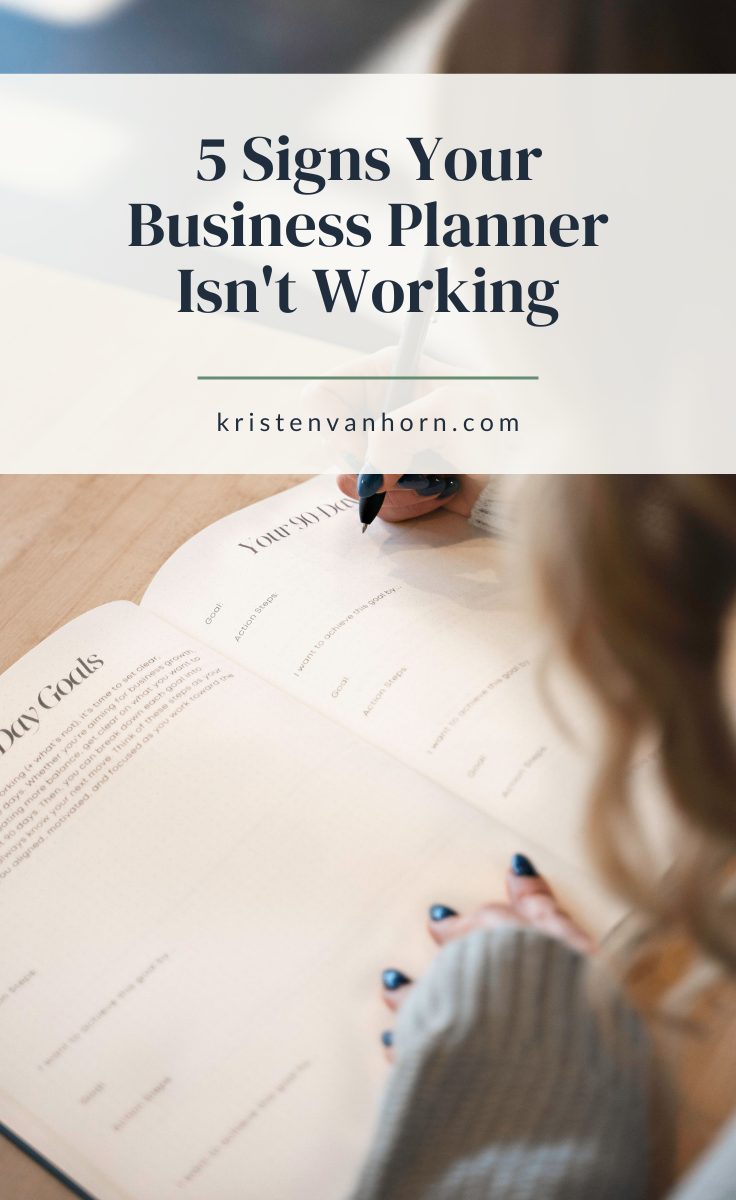
Already know you're ready for a planning system?
The SYS Planner is the business planner I built with the system already inside it.
What's the difference between a planner and a planning system?
A planner is the tool. A planning system is the process you follow every week to decide what goes in that tool, what comes first, and when you'll do it.
I was a phys ed teacher for 8 years, so here's how I think about it...
A gym full of equipment doesn't teach anybody anything. The lesson plan does.
Your planner is the equipment. Your system is the lesson plan.
A planner records information. A system organizes your decisions.
ONE // Why am I so busy but my business isn't growing?
Because being busy and growing your business are two different things... and without a system, the easy stuff wins every time.
It's 3PM. You're closing your laptop to go pick up your kids. You worked ALL day.
But when you look at your list, nothing on it actually moved your business forward.
This usually looks like:
Crossing off tasks but never finishing projects
Starting new ideas before finishing the ones that matter
Getting to Friday and wondering what you actually did all week
A planner helps you remember what to do. A system helps you decide what's worth doing.
Busy is not a badge of honor.
(If this one hit a little too close to home, I wrote a whole post on what's actually wrong when you're busy but not growing your business.)
TWO // Why can't I stick to my planner?
Most people can't stick to a planner because they make a great plan on Monday... and have no way to get back on track when the week falls apart. The issue isn't discipline. It's structure.
Raise your hand if this is your week:
Monday: You map out the PERFECT week and feel amazing
Wednesday: The school calls because your kid is sick. Then a client emails that something on her website broke.
Thursday: The planner stays closed
Next Monday: You start over. Again.
Believe me... I KNOW you're full of ideas. Making plans isn't the hard part. Sticking to them is.
A planning system gives you a repeatable process so one bad day doesn't wipe out the whole week.
For me, that's my weekly Top 3. Even when the week blows up, I know the 3 things that HAVE to happen. Everything else is extra.
One of my planner customers said it best: "I've never stuck with one before, but I like how much space yours has. It's super simple and there's no fluff."
You don't need more discipline. You need a plan that bends without breaking.

THREE // How do I know what to prioritize in my business each week?
Pick 3 priorities each week by asking which tasks connect to your 90-day goal and which ones help you make sales. Everything else goes on the "later" list.
If you sit down to work and stare at your screen trying to decide... client work? Content? Email? Admin? That big goal you set in January?
That's a sign you need more than a list.
Here's the question I ask myself every single day: "What did I do to sell today?"
Because most businesses need about 80% of your time spent on marketing (emails, posts, following up with leads) and only 20% on everything else. But most of us do it the opposite way.
A system helps you:
Pick your priorities BEFORE you sit down
Connect what you do this week to your 90-day goals
Tell the difference between urgent tasks and the work that actually grows your business
When you know your priorities, your week has direction. And direction gets RESULTS.
You don't need more strategy. You need more structure.

FOUR // Why does my schedule feel out of control?
Your schedule feels out of control when every day starts as a blank page... so whatever is loudest gets your time. Simple routines + boundaries fix that.
You might be dealing with this if:
One interruption throws off your entire day
You jump between tasks constantly
Recurring work (like emails or posting) has no set time
You always feel like you're "catching up"
This is exactly why I use theme days.
Mondays are my CEO day (I look at my numbers + plan the week). Tuesdays + Thursdays are client calls or marketing. Wednesdays are for bigger projects. Fridays are my reset.
Every day already has a job, so I'm not making that decision 5 times a week.
Structure creates freedom.
(Want to see exactly how I set this up? Here's my weekly planning routine that grows my business in 4 hours a day.)
FIVE // Is a 90-day planner better than a yearly planner?
For most small business owners, yes. 90 days is long enough to make real progress and short enough that you can actually see the finish line.
Here's what usually happens with yearly planning... you set big goals in January, and by March you can't remember what they were. (No judgment. Same.)
And if you're planning month to month with no bigger picture? Your work will always feel scattered.
A 90-day planning window gives you:
A direction for the whole quarter
Room to make progress without rushing
Enough structure to build momentum
Enough flexibility for when life happens (summer break, sick days, the school play you forgot was this week)
This is why I made the SYS Planner a 90-day business planner.
I pictured my planner on the shelf at Target for about 5 years... and spent about 2 of those years sketching the layout in a dot grid notebook. 90 days was the one thing I never changed.

What should a business planner include?
A good business planner gives you 3 things: a plan for your quarter + your week, a short list of priorities, and routines that protect your time. That's the SYS Method™.
✨ PLAN: Set your 90-day direction, then build a weekly schedule that matches it. You always know what you're working toward + when you're working on it.
✨ PRIORITIZE: Each week, focus on the few things that actually get you closer to your goals (without giving up your whole life to do it).
✨ PROTECT: Build routines + boundaries so your time and energy stay on what matters... even when life gets busy.
Plan. Prioritize. Protect. That's how you grow your business without working longer hours.
So... do you need a new business planner?
Honestly? Probably not another random one.
You need a planner with the system built in... or a system you'll actually use with the planner you already have.
This is your permission slip to stop buying planners hoping the next one fixes everything.
You don't need a prettier planner. You need a plan you'll actually follow.
Ready for a business planner that actually works?
If you saw yourself in 2 or more of these signs, that's exactly why I created the SYS Planner.
It's a 90-day business planner with my SYS Method™ built right in... your 90-day goals, your weekly Top 3, and your schedule all live in one place. No sticky notes. No five different notebooks. No more planner graveyard under your desk.
And you don't have to be a Type A planner person to use it. One customer told me: "I'm not type A, I'm type squirrel so it's awesome!!"
